Fast, Reliable Attic Insulation Across Portola Hills
Attic insulation in Portola Hills typically costs between $1,800 and $4,200 for a standard single-family home upgrade, with radiant barrier work adding $1,100 to $2,600 depending on roof pitch and square footage. Most projects in the 92610 ZIP code take one to two days once materials are staged. If your attic runs hot every afternoon and your AC struggles through Santa Ana weeks, the problem isn’t your HVAC – it’s almost certainly what’s above your ceiling. Call Legend Insulation at (877) 679-4725 and we’ll walk your attic with you, explain what we find, and give you a straight answer on what actually needs to change.
We work throughout Portola Hills every week – from the tracts off Glenn Ranch Road to the hillside communities along Ridgeline and Saddleback Ranch. Nolan Cassidy built Legend Insulation around a simple idea: an insulation contractor should recommend what performs, not what’s convenient to stock. That’s why we carry eight major brands and three installation methods, and why the conversation always starts with your attic’s actual condition, not a sales sheet.
Why Legend Insulation Is Portola Hills’s Preferred Attic Insulation Company
Portola Hills homeowners call us because we show up already knowing what their attic looks like. The tract homes here – mostly 1980s and 1990s builds on graded canyon slopes – share a distinct set of problems: original fiberglass batts that have collapsed, shallow-slope ceilings that complicate access, and HOA architectural review that means changes need to stay within community standards. We’ve worked on enough of these homes to know what to expect before we climb the ladder.
Our crews reach Portola Hills fast, usually same-day for estimates and within a few days for scheduled work. Being based in nearby Trabuco Canyon helps; we’re not driving in from the coast. That proximity matters when you’re dealing with an attic that’s been cooking at 140 degrees and you want it fixed before the next heat spike.
What differentiates us: we’re a dedicated insulation contractor, not a general contractor who insulates on the side. Every crew member, every truck, every dollar of training goes into one trade. For a Portola Hills homeowner, that means the person in your attic can explain the difference between a radiant barrier and a radiant-barrier paint, between R-38 fiberglass and R-38 blown-in cellulose – and which one actually solves your hot-side problem. Attic, blown-in, or spray foam – we’ll tell you which method actually solves your problem.
Radiant Barrier in Portola Hills
Radiant Barrier in Portola Hills is the single most effective upgrade for canyon-slope tract homes where the sun-facing roof pitch turns attics into ovens by mid-afternoon. A radiant barrier is a reflective material – typically foil-faced – installed under the roof deck to reflect radiant heat before it enters the attic. In a Portola Hills home with a southwest-facing pitch, that can drop attic temperatures by 20 to 30 degrees on a hot day. The work involves stapling or securing the barrier to the underside of the roof rafters, with proper air gap maintained against the roof deck – not laying it flat over insulation, which is a common mistake that makes it ineffective.
A typical radiant barrier installation in Portola Hills runs $1,100 to $2,600, depending on roof square footage, pitch accessibility, and whether we’re also air-sealing recessed lights and top plates while we’re up there. Most homeowners combine it with new fiberglass or blown-in insulation for a complete Title 24-aligned upgrade.
Hot-Side Targeted Installation
Because Portola Hills homes sit on canyon slopes, many attics have asymmetric ceiling lines – one roof plane runs longer or steeper than the other. Installing a radiant barrier on every surface sounds thorough, but on these homes it wastes money. The hot side is where radiant heat concentrates, and that’s where the barrier does its real work. We map the sun exposure before we quote, so you’re not paying for reflective material on a north-facing pitch that barely sees sun.
Pairing Radiant Barrier With Air Sealing
Radiant barrier reflects radiant heat, but it doesn’t stop convective airflow through gaps around recessed lights, top plates, and plumbing penetrations. In Portola Hills, those gaps also pull fire-season smoke into the house – a complaint we hear often from homeowners whose indoor air turns hazy every time smoke settles over the Saddleback Valley. We recommend air sealing as part of any radiant barrier project, using foam or caulk at every penetration before the new insulation goes in.
Attic Cleaning Services in Portola Hills
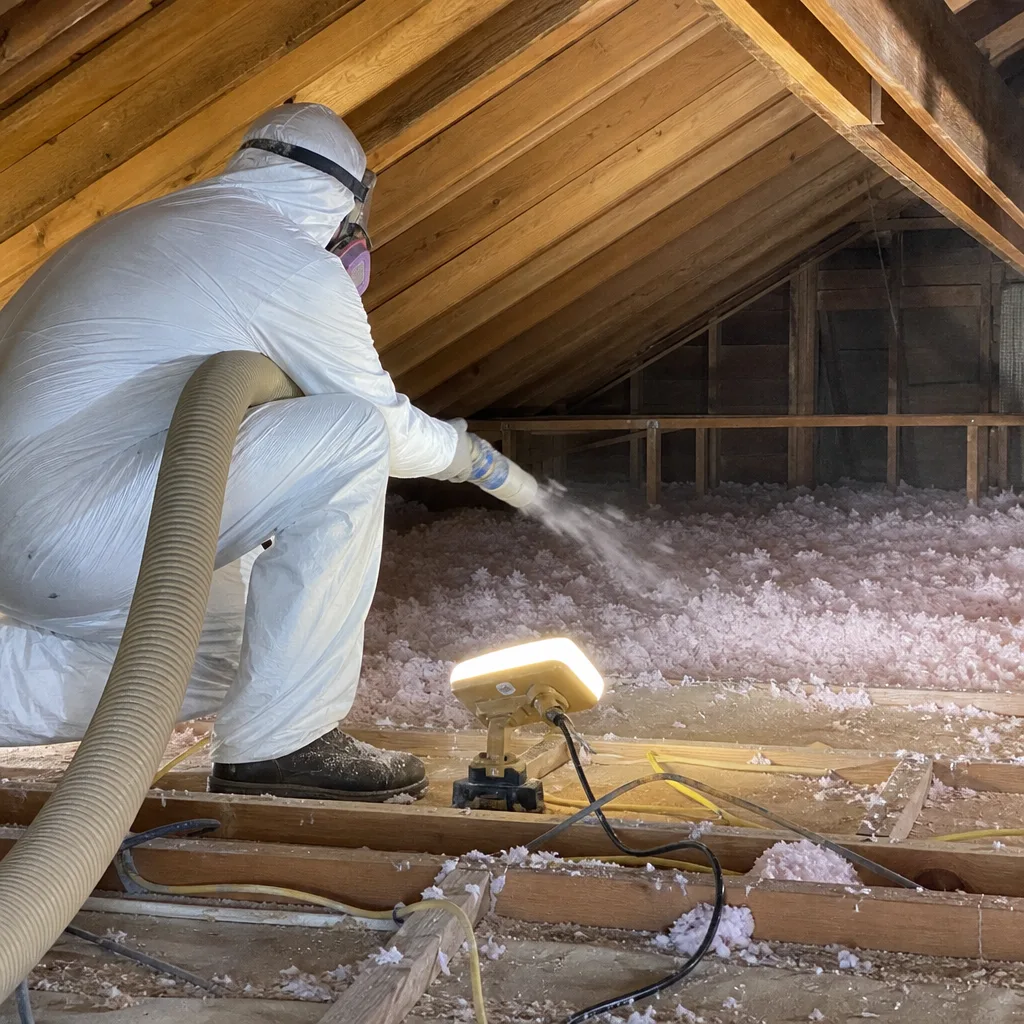
Attic Cleaning Services in Portola Hills are for homeowners whose attics have accumulated years of dust, rodent activity, or degraded fiberglass fragments that shouldn’t be recirculating through ceiling leaks into living space. The work involves removing old or contaminated insulation, vacuuming the attic floor and joist bays, sanitizing where needed, and preparing the space for new insulation or a radiant barrier. In canyon-adjacent neighborhoods, we also find blown-in dust and debris from the dry Santa Ana winds that push through soffit vents and attic louvers.
Attic cleaning in Portola Hills typically runs $900 to $2,200, depending on attic size, accessibility, and whether we’re removing old insulation at the same time. A full clean-and-re-insulate package usually lands between $2,800 and $5,500 for a standard tract home.
Pre-Insulation Removal and Prep
The original R-11 batts in many 1980s and 1990s Portola Hills homes haven’t just underperformed – they’ve physically broken down. Fiberglass fibers crumble, paper facings tear, and in the worst cases, the batts have pulled away from the roof deck entirely, leaving open gaps at the eaves where heat pours in. Before new insulation goes in, the old material has to come out. We bag and remove everything, then clean the deck so the new material actually lies flat and performs at its rated R-value.
Rodent and Pest Remediation Prep
Canyon-slope communities have rodent pressure that flatland neighborhoods don’t – pack rats, roof rats, and field mice move through the brush along Ridgeline and the surrounding open space. When they nest in insulation, the material isn’t just unsanitary, it’s compressed and ineffective. Our attic cleaning includes removal of contaminated insulation and sanitizing the affected areas before we install new material, so you’re not laying fresh fiberglass over a problem that hasn’t been removed.

What happens when you call
- 1
A real person answersNo phone trees — you reach a local pro.
- 2
You get an upfront price rangeHonest numbers before anyone is dispatched.
- 3
A background-checked tech heads outLicensed & insured, dispatched right away.
- 4
You approve before work beginsNothing starts until you say go.
Trusted Brands We Service in Portola Hills
Legend Insulation carries CertainTeed, Owens Corning, Johns Manville, Knauf, Rockwool, Icynene, Demilec, and GreenFiber – eight of the industry’s most trusted brands, so we recommend what performs, not what’s convenient. If your Portola Hills attic has existing CertainTeed batts and you want a top-up that matches, we can do that. If you’re exploring Icynene or Demilec spray foam for air-sealing a tricky shallow-slope ceiling, we’re certified in both systems. And if your HOA wants fire-resistance documentation for an attached-wall application, we can spec Rockwool’s mineral wool with the paperwork an architectural review board needs. For Portola Hills customers, we keep common material sizes and brand-match options readily available, which shortens turnaround from estimate to install.
Insulation is all we do, which means it’s all we’ve perfected. From fiberglass to mineral wool to spray foam, we speak every material.
Common Attic Insulation Problems We See in Portola Hills Homes
- Collapsed original R-11 batts at the eaves. The 1980s and 1990s tract builds along the canyon slopes came with minimal insulation by today’s standards, and decades of gravity and thermal cycling have pulled it away from the roof deck. The result is a continuous uninsulated band at the eaves where radiant heat enters the attic untouched.
- Asymmetric roof pitches that cook one side of the house. A home with a long southwest-facing pitch above the living room will always be hotter on that side unless the insulation and radiant barrier are concentrated there. Uniform upgrades treat every surface the same, which leaves the hot pitch underprotected and the home uncomfortable during Santa Ana events.
- Missing air sealing around recessed lights and top plates. Original-build homes were not air-sealed to current Title 24 standards, and every unsealed penetration lets conditioned air escape and outside air – including fire-season smoke – enter. This is one of the most common indoor-air-quality complaints we hear from Portola Hills residents.
- HOA compliance concerns on attic access changes. If an upgrade requires a new attic access or changes visible roofline venting, the Portola Hills HOA may need to review it. We prepare documentation and material specs in advance so your board review doesn’t stall the project.
Pricing for Attic Insulation in Portola Hills, CA
Here’s what you can expect to pay for attic work in Portola Hills. A basic attic top-up with blown-in fiberglass or cellulose runs $1,200 to $2,400 for a standard single-family tract home. Full removal and replacement with R-38 fiberglass batts runs $2,200 to $4,200. Radiant barrier installation adds $1,100 to $2,600, and attic cleaning alone ranges from $900 to $2,200. The biggest cost variables are roof pitch (steeper, canyon-slope attics take longer to work in), existing insulation condition, and whether air sealing is included. For an exact quote on your Portola Hills home, call (877) 679-4725 – estimates are free, and we’ll walk the attic with you so you understand exactly what you’re paying for.
We Also Serve Cities Near Portola Hills
Legend Insulation serves the wider Saddleback Valley region, including Portola Hills and nearby communities. If you’re in Foothill Ranch, Lake Forest, Mission Viejo, or Trabuco Canyon, we bring the same material-neutral recommendation and attic-first diagnosis to your home. Our Attic Insulation team works throughout the foothills and can usually schedule within days, not weeks, for standard attic upgrades.
Serving Portola Hills, CA — Our Local Coverage Area
We’re based in the Portola Hills area and know this community well. Use the map below to see our service coverage — if you’re nearby, we can almost certainly help.
FAQs About Attic Insulation in Portola Hills
Most interior attic work – insulation, radiant barriers, air sealing – does not require Portola Hills HOA architectural review because it’s not visible from the street. However, if your project involves changing attic vents, adding roof penetrations, or altering any exterior element, board approval is typically required. We can provide material specifications and installation documentation to submit with your application, and we’ve handled enough Portola Hills projects to know what the board wants to see. Call (877) 679-4725 and we’ll help you determine whether your specific upgrade needs a filing.
Current California Title 24 building standards recommend R-38 attic insulation for most Portola Hills homes, though the exact requirement depends on your specific zone and home configuration. Many original-build tract homes from the 1980s and 1990s have R-11 to R-19, which is well below today’s standard. Upgrading to R-38 fiberglass or blown-in material, combined with air sealing, typically brings a home into compliance and delivers the most noticeable comfort gain during Portola Hills’ hot summer afternoons and Santa Ana heat events.
Canyon-slope homes often have asymmetric roof pitches, meaning one side of the roof slopes longer or at a different angle than the other. The sun-facing pitch absorbs far more radiant heat, so radiant barrier installed there delivers significantly more benefit than barrier on the shaded side. We evaluate your roof orientation before recommending placement, so you’re not paying for material where it won’t pay you back. A targeted hot-side installation is usually the more intelligent spend than a full-attic blanket application.
Yes. Because Legend Insulation carries Owens Corning, Johns Manville, Knauf, CertainTeed, Rockwool, Icynene, Demilec, and GreenFiber, we can match the brand and type already in your attic when a top-up or patch is the right approach. That matters in Portola Hills because many homes have partial original insulation that’s still functional in some areas but collapsed in others. We’ll tell you honestly whether matching and patching makes sense, or whether a full replacement is the smarter long-term move. Call (877) 679-4725 for a free attic assessment.
Air sealing closes the gaps around recessed lights, top plates, plumbing penetrations, and attic access hatches – the small openings where outside air enters your living space. During fire season, when smoke settles over the Saddleback Valley and Portola Hills, those same gaps pull smoky air into the house. Properly sealed penetrations reduce smoke intrusion and improve indoor air quality, while also making your insulation more effective. In canyon communities with brush and wildland exposure, air sealing is one of the highest-value upgrades we recommend alongside insulation and radiant barrier.
Written by Nolan Cassidy, Owner at Legend Insulation, serving Portola Hills and the Saddleback Valley.