
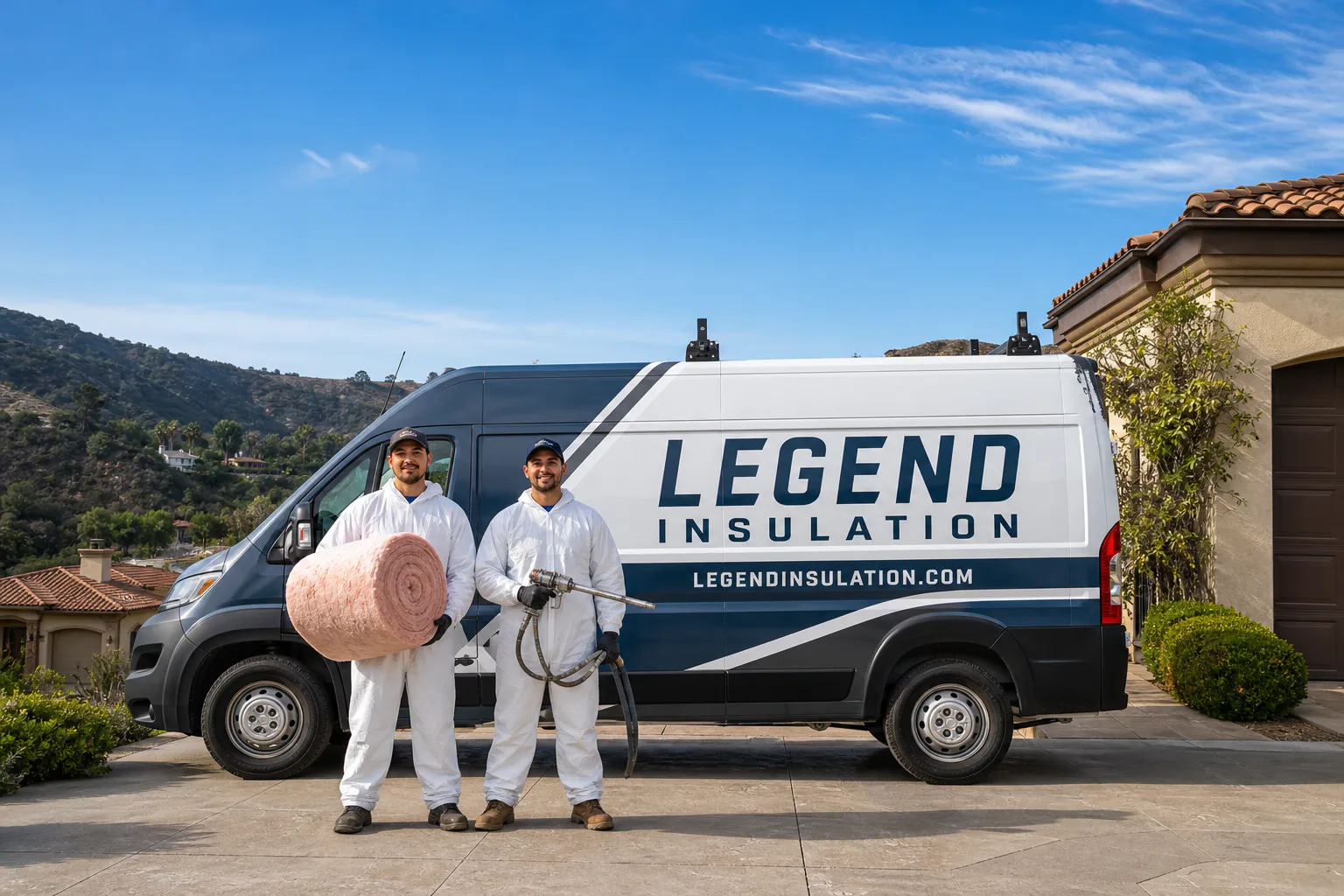
Fast, Reliable Spray Foam Insulation Across Portola Hills
Spray foam insulation in Portola Hills typically costs $2.50 to $6.50 per board foot for closed-cell and $1.00 to $2.50 for open-cell, depending on the surface and the condition of what’s already up there. Most Portola Hills jobs can be scheduled and completed within a week, and attics here rarely take more than a day or two once we’re on site. If you’re in the 92610 zip and your attic cooks the upstairs by midafternoon, call (877) 679-4725 and we’ll walk you through what’s actually happening up there.
We work Portola Hills regularly. We know the tract layouts off Saddleback Ranch Road, the graded lots along Glenn Ranch Road, and the way the afternoon sun lands on the south-facing pitches above the Saddleback Valley. Local knowledge means we plan the foam application around the actual heat load on your roof deck, not just a square-footage estimate.
Why Legend Insulation Is Portola Hills’s Preferred Spray Foam Insulation Company
Portola Hills homeowners call us because this community sits on canyon ridges, and the insulation problems here are not like Anaheim or Irvine. The homes are 1980s and 1990s planned tracts on graded slopes, and the defining issue is radiant-heat gain on the sun-facing pitch. Nolan Cassidy built Legend Insulation around a simple idea: carry every major material so the recommendation matches the house, not the truck.
We stock Icynene and Demilec spray foam systems, which means we are not pushing one foam chemistry on every job. For a Portola Hills attic with an asymmetric ceiling line, closed-cell Demilec on the hot side and open-cell Icynene on the shaded side is often the right combo. That kind of material-neutral call is why Portola Hills homeowners and the contractors who work here keep our number in their phones.
We’re insulation-only. No roofing, no HVAC, no siding jobs booked between your start time and your finish time. Every crew member who steps onto a Portola Hills job is there for one trade, and that focus shows in how we handle HOA-mapped exteriors and shallow-slope attic access without drama. Call (877) 679-4725 for an estimate that reflects the actual condition of your attic, not a generic per-square-foot bid.
Garage Spray Foam Insulation in Portola Hills
Garage spray foam insulation in Portola Hills is one of the highest-impact upgrades we do here, because the garage is where the heat and the smoke enter first during a Santa Ana event. Garages on these tract homes are built under the living space or attached on the south side, and the ceiling assembly is often just drywall over open framing with no thermal break. Sealing that ceiling with closed-cell foam does two things at once: it keeps the garage from radiating heat up into your bedrooms, and it blocks the smoke intrusion that comes through the top plates and rim joists when the winds push ash down the canyon.
What a Portola Hills garage job actually involves
We map the ceiling cavities, air-seal the rim joist and top-plate gaps first, then apply foam in a continuous layer across the garage ceiling. The HOA angle matters here because we keep everything interior-only – no exterior vents, no visible changes, no architectural review surprises.
Expect a Portola Hills garage ceiling to run $1,800 to $3,400 for closed-cell spray foam on a standard 400-ish square foot footprint. Shallow-slope access or an attached workbench wall will push the labor slightly, but the material cost is predictable because we quote from the actual cavity map, not a hallway measurement.
HOA and architectural review reality
Portola Hills HOAs are strict about exterior appearance. Garage foam work requires zero exterior modification, which means it sails through any architectural review process because there is nothing to review. We have done dozens of these in the 92610 and the only paperwork ever involved is the estimate.
Closed Cell Spray Foam Insulation in Portola Hills
Closed cell spray foam insulation in Portola Hills is the workhorse material for the canyon-slope attics we see between Glenn Ranch Road and the ridge line. It cures rigid, adds structural strength to the roof deck, and delivers roughly R-6.5 to R-7 per inch – enough to flip a south-facing pitch from a heat radiator into a real thermal barrier. In the 1980s and 1990s homes here, the original R-11 to R-19 fiberglass batts have sagged and pulled away from the deck at the eaves, so the attic stops fighting heat gain exactly where the sun hits hardest.
Hot-side roof deck application
On a Portola Hills home with an asymmetric ceiling line, we target the sun-facing pitch with closed-cell foam rather than blanketing the entire attic. The shaded side can often handle open-cell or a thinner lift; the hot side needs the density and air-seal that only closed-cell delivers. This targeted approach cuts material waste and actually performs better than a uniform layer.
When closed-cell makes sense over open-cell
Closed-cell is the right call on any Portola Hills roof deck that’s absorbing direct afternoon sun for five or six hours a day from June through October. It also wins when the homeowner wants air-sealing built into the same pass, which matters during fire season when smoke pushes through gaps around recessed lights and top plates. A typical Portola Hills closed-cell attic application runs $4,200 to $8,900 depending on square footage and how much of the original batt material needs removal first.
Trusted Brands We Service in Portola Hills
Legend Insulation carries Icynene and Demilec spray foam systems side by side, and that matters because Portola Hills attics rarely call for one chemistry across the whole roof. Icynene open-cell gives us a lighter, more forgiving layer for shaded pitches and interior walls. Demilec closed-cell gives us the rigid, air-sealing performance the sun-facing side actually needs. Because we stock both, we recommend based on your roof pitch and heat exposure, not on what’s left on the truck. Portola Hills customers also get access to CertainTeed fiberglass and GreenFiber cellulose when a hybrid approach – foam on the deck, blown-in elsewhere – is the smarter play. We’re also the local team that knows how to work Spray Foam Insulation into an HOA-mapped home without touching the exterior.
Common Spray Foam Insulation Problems We See in Portola Hills Homes
- Uniform foam blankets across asymmetric attics. A single-thickness spray foam layer across the entire roof deck wastes material on the shaded side and under-insulates the sun-facing pitch. In Portola Hills, where the canyon slope angles the roof into the afternoon sun, this is the most common mistake we correct from previous foam jobs.
- Open gaps around recessed lights and top plates. Santa Ana heat and fire-season smoke push right through unsealed penetrations. We find these unsealed gaps in nearly every 1980s and 1990s tract home in the 92610 that hasn’t had dedicated air-sealing work.
- Sagging original R-11 to R-19 batts. The fiberglass installed at original build has collapsed and pulled away from the deck at the eaves. Foam applied over or next to these failed batts traps air gaps and moisture against the roof deck, which shortens the life of the new work and the sheathing.
- Shallow-slope attic access ignored. Portola Hills attics are often tight, with shallow pitch and limited clearance. A crew that doesn’t plan for this leaves sections of the roof deck untreated, especially near the eave lines where heat penetration is concentrated.
Pricing for Spray Foam Insulation in Portola Hills, CA
A full attic spray foam retrofit in Portola Hills runs $4,200 to $8,900 for closed-cell on a standard 1980s – 90s tract home, with open-cell attics landing between $2,800 and $5,600. Garage ceiling foam work runs $1,800 to $3,400, and rim joist sealing alone starts around $900. The biggest cost drivers are how much old batt material needs removal and how much of the roof deck is on the sun-facing pitch. We quote Portola Hills jobs from an attic walkthrough, not a satellite photo. Call (877) 679-4725 for a free estimate and we’ll give you real numbers for your exact roofline.
We serve all of Portola Hills and the surrounding foothill communities. If you’re in Foothill Ranch, Lake Forest, Mission Viejo, or Trabuco Canyon, you’re in our regular service area and we can usually get to you just as quickly. For a full overview of our service area, see Spray Foam Insulation in Portola Hills and the surrounding neighborhoods we cover.
Serving Portola Hills, CA — Our Local Coverage Area
We’re based in the Portola Hills area and know this community well. Use the map below to see our service coverage — if you’re nearby, we can almost certainly help.
FAQs About Spray Foam Insulation in Portola Hills
Spray foam insulation applied to the attic, garage ceiling, or rim joists is entirely interior work, so it does not trigger a Portola Hills HOA architectural review. There are no exterior penetrations, no visible vents, and no changes to the roofline or street-facing facade. We work this way deliberately on Portola Hills homes because the HOA-mapped exteriors here leave no room for unapproved exterior modifications. If your specific association has questions, we can provide a scope letter describing the interior-only nature of the work. Call (877) 679-4725 and we’ll talk through your HOA’s specific CC&Rs.
Because your attic ceiling line is asymmetric, the pitch that faces the afternoon sun absorbs far more radiant heat than the shaded side, and a uniform foam layer leaves that hot side under-protected. In Portola Hills, where homes sit on graded canyon slopes, the south- and west-facing pitches can run 40 to 60 degrees hotter than the opposite side during a summer afternoon. We apply closed-cell foam to the hot-side roof deck and lighter open-cell or a thinner lift to the shaded side, which matches the material to the actual heat load instead of blanketing everything evenly.
Yes, and for many Portola Hills homeowners the garage is the single most effective place to start with spray foam. Santa Ana winds push heat and smoke through the rim joist, top plates, and the unsealed ceiling assembly, and the garage is where that pressure enters first. Closed-cell foam on the garage ceiling and rim joist stops both the radiant heat moving up into the bedrooms above and the smoke moving through the framing gaps. During fire season, this is the upgrade that makes the difference between a house that smells like ash and one that doesn’t.
Yes, and it should. The original fiberglass batts in Portola Hills tract homes have collapsed and pulled away from the roof deck at the eaves, leaving air gaps where the sun’s heat enters first. Spray foam applied after removing or bypassing those failed batts creates a continuous air-sealed layer against the deck, which is what the original insulation never achieved even when it was new. We map every cavity, remove what’s failed, and foam the deck directly.
We install Icynene and Demilec spray foam systems, which gives Portola Hills homeowners access to both open-cell and closed-cell chemistry from two of the most respected names in the industry. Icynene open-cell works well on shaded pitches and interior walls. Demilec closed-cell delivers the rigid, air-sealing performance the sun-facing side needs. Because we stock both, the brand and chemistry are matched to your actual roof load, not to whatever a single-brand installer happens to carry. Call (877) 679-4725 for a walkthrough and we’ll show you exactly what’s on your roof deck and what it needs.
On a tract home off Saddleback Ranch Road, our crew found original R-11 batts sagging away from the roof deck at the eaves and a sun-facing pitch that was cooking the attic by early afternoon. We air-sealed the top plates and recessed-light gaps against fire-season smoke intrusion, then applied closed-cell spray foam to the hot-side roof deck and sealed the garage ceiling assembly – cutting the radiant-heat load without disturbing the HOA-mapped exterior. That’s the Portola Hills job in a sentence: targeted, interior-only, and built around the way the sun actually lands on your roof.
If your Portola Hills attic is hot by noon and your upstairs barely cools at night, the insulation you have is not doing its job. Call Legend Insulation at (877) 679-4725 for a free estimate. We’ll walk your attic, map the heat load, and give you a number that reflects your actual roof pitch and existing conditions – not a generic square-footage quote.
Written by Nolan Cassidy, Owner at Legend Insulation, serving Portola Hills and the surrounding Saddleback Valley foothills.